ENERGO-PRO raised the issue of network security in the framework of the forum “Development of electricity networks - European and national trends and problems”
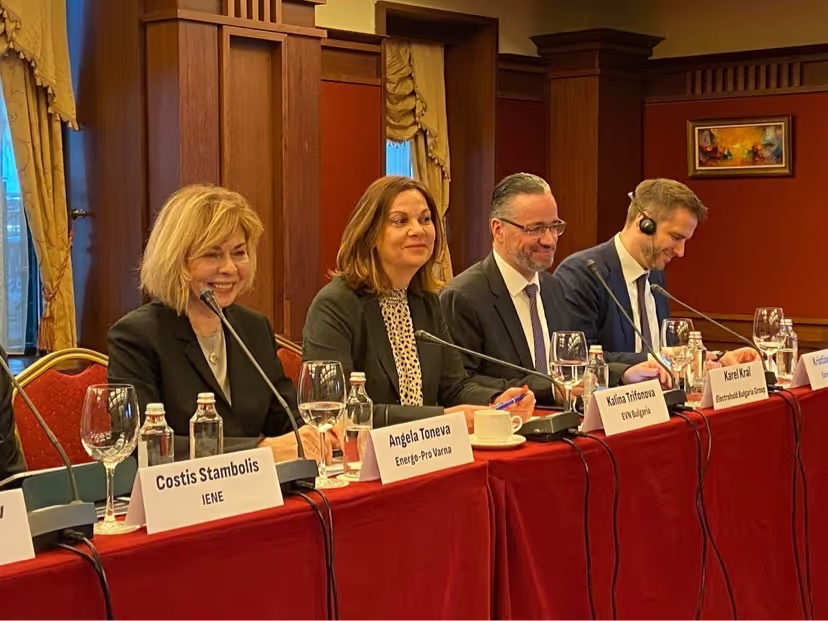

The managers of ENERGO-PRO Varna took part in a round table dedicated to the development of electricity networks, which took place on 23.02.2023 in Sofia. The event was organized by the Institute of Energy Management. The meeting discussed the significant increase in applications for the connection of new RES capacities to the electricity distribution network in the context of the recent changes in the SEBI. On the part of ENERGO-PRO, Angela Toneva reported that for 2022 compared to 2021, the number of submitted applications for connection of RES increased by 69%, the declared capacity was increased in one year by 209%. The claimed capacity for own consumption increased by 132% compared to 2021, despite the fact that of the submitted requests it is still only 15%. At the beginning of this year, the total average hourly load consumption is in a comparative balance with the installed capacity for renewable energy production. In the event of an intensive increase in installed capacity for renewable energy production, decreasing consumption and the inability to invest in the grid, the achieved balance between consumed and transferred energy will be drastically disturbed.
Leading speeches were also made by representatives of the boards of Electrohold and EVN, Christian Ruby, Secretary General of Eurelectric and Dean of the Faculty of Economics at Sofia University Atanas Georgiev. According to the forum participants, the problem lies in the fact that investors are looking for places to install power plants near the grid with a lack of consumption, but the shortage of network capacity predetermines the need to prescribe higher connection costs. Network operators are increasingly required to connect to the networks of new producers with minimal costs for the construction of connection facilities, but neither the regulatory price framework nor the current legal procedures allow timely and rhythmic renewal of the network infrastructure in the direction of distribution of the generated renewable energy.
At the same time, the recently adopted legal facilitations for the construction of solar installations for own needs do not require coordination with the ERPs, which creates the risk of overloading the grid and the risk of violating safety standards. All agreed that there was a need for a legal opportunity for distribution system operators to have information and technical control over these installations.
On the other hand, investments in distribution networks, which will be entirely the result of the need to connect renewable energy capacities, will lead to an additional financial burden for all users of the distribution networks, in the form of an inevitable increase in network tariffs for all end users against the background of the ongoing crisis related to electricity prices and high inflation. Leasing. The meeting stressed that the financial burden for increasing the capacity of networks should be distributed among renewable energy investors, network operators and through the provision of grants. This will lead to a fairer transition to green energy.
The participants of the forum summarized that a nationwide policy is needed that stimulates the construction of renewable energy sources only for own needs, but also to create economic conditions for increasing consumption in places where it has been drastically reduced in recent years. In North-East Bulgaria there are the most urbanized areas in which almost nothing is consumed anymore, there is no available capacity in the facilities, the power lines do not have the ability to carry large amounts of energy, the substations are practically exhausted, and the requests for installation of renewable energy are many, including for sale.
A good solution is to ensure the political will to grant investment grants to network operators and ease the procedures of the investment process, measures that will fully benefit both end customers and renewable energy producers.